
When to Repair and When to Replace a Retractable Mesh
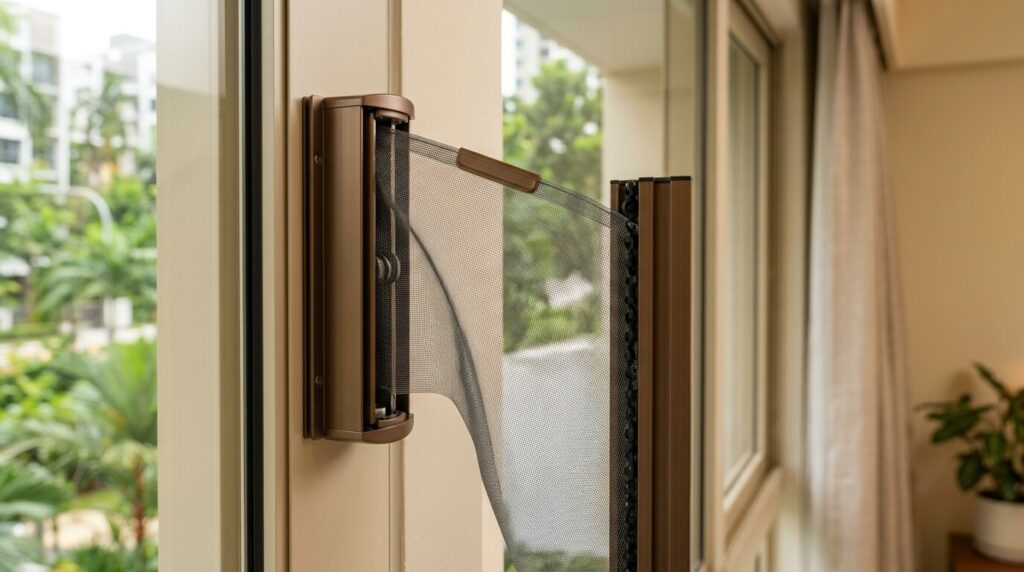
Retractable mesh is built to be used many times a day for years, so when one starts misbehaving the instinct is to assume it has worn out. Often it has not. A good share of problems come from dirt, obstruction or a small part rather than the system itself — and knowing the difference saves both money and unnecessary work.
Usually a Repair
It Retracts Slowly or Stiffly
Nearly always debris in the track. Dust, hair, leaves and sand build up in the channel and the mesh has to drag through it. A careful clean of the tracks resolves most cases of this, and it is the first thing to try before assuming anything is broken.
It Will Not Stay Closed
Typically a catch or magnet that is dirty or slightly out of alignment rather than a failed mechanism. Cleaning the contact surfaces and checking the alignment often restores it.
It Judders Instead of Moving Smoothly
Usually uneven build-up along one side of the track, or the mesh sitting slightly askew in its channel. Both are adjustable.
A Small Tear in Otherwise Sound Mesh
A localised tear away from the edges can often be repaired rather than replaced, particularly if the surrounding mesh is still taut and undamaged.
Usually a Replacement
The Mesh Has Gone Slack Overall
General sagging across the whole panel means the mesh itself has stretched and lost tension. Tension is not something that can be restored by cleaning, so this is a genuine end of life.
Damage Along the Edges
Where mesh meets its channel is the critical join. Fraying or pulling away along that edge undermines the whole system — and on pet-friendly mesh it is a safety issue, not a cosmetic one.
The Spring Mechanism Has Failed
If the mesh no longer retracts under its own tension after the tracks are clean, the mechanism itself has gone. On most systems this is not economically worth rebuilding.
The Housing Is Cracked or Distorted
Damage to the cassette or side channels means the mesh can no longer run true, and every other problem follows from it.
What Actually Shortens a Mesh’s Life
- Letting it snap back rather than guiding it — the single hardest thing on the spring
- Retracting it while damp, which traps moisture inside the housing
- Leaving grit in the track until movement becomes forced
- Forcing a sticking mesh instead of finding the obstruction
The Sensible Order
Clean the tracks thoroughly and try again. If it improves, it was dirt. If nothing changes after a proper clean, have it looked at rather than continuing to force it — forcing a jammed mesh is what turns a repairable fault into a replacement.
Not Sure Which You Are Looking At?
Send a short video of the mesh moving and its behaviour usually tells us straight away whether it needs a service or a replacement.
Not Sure Which You Are Looking At?
Planning replacements across several windows? WhatsApp Ristoire at +65 8878 4383 to arrange a site visit, or get a quick idea of cost first with our quote calculator at /calculator.
Related Articles
Door Mesh Singapore: Why More Homeowners Are Adding Retractable Mesh to Their Doors
September 24, 2026Ready to Transform Your Home?
Book a free site visit and we will measure your windows, recommend the right setup and give you a clear, no-obligation quote.